

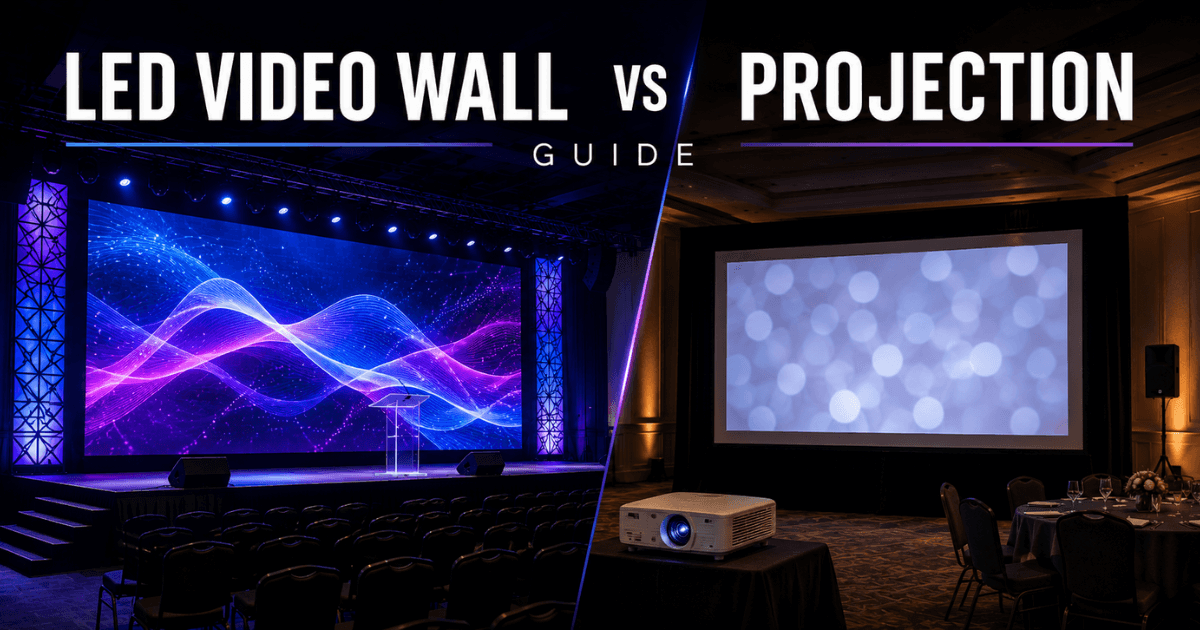
Choosing the right display technology can significantly influence the success of your event. Whether you’re planning a conference, trade show, corporate meeting, product launch, gala dinner, or outdoor event, your audience needs to clearly see every presentation, video, and piece of visual content. Two of the most common display solutions are LED video walls and projectors, but each has its own strengths, limitations, and ideal use cases.
Many event organizers automatically choose a projector because it’s familiar, while others assume an LED video wall is always the better option. In reality, the best choice depends on your venue, audience size, lighting conditions, content, and overall event objectives.
At Summit Event Production, we help organizations throughout Toronto select the right display technology for conferences, exhibitions, product launches, and corporate events. Whether you’re planning a Conference Event Management project, a Corporate Event Planning initiative, or complete Conference & Summit Production, understanding the differences between LED video walls and projectors will help you make an informed decision.
Understanding the Difference
Although both technologies display visual content, they work in completely different ways.
A projector creates an image by projecting light onto a projection screen or flat surface. The quality of the image depends heavily on room lighting, screen quality, projection distance, and projector brightness.
An LED video wall is made up of individual LED display panels that generate their own light. Instead of projecting an image, the display itself produces bright, vibrant visuals that remain visible even in challenging lighting conditions.
Because of this fundamental difference, each technology performs differently depending on the event environment.
What Is an LED Video Wall?
An LED video wall consists of multiple modular LED panels connected together to form one seamless display.
These displays are commonly used for:
- Conferences
- Trade shows
- Corporate meetings
- Product launches
- Award ceremonies
- Concerts
- Outdoor festivals
- Sporting events
Professional LED Wall Rental allows organizers to customize screen size, aspect ratio, and installation method based on venue requirements and audience size.
What Is a Projector?
A projector displays images by shining light through a lens onto a projection screen.
Projectors are commonly used for:
- Board meetings
- Small classrooms
- Internal presentations
- Training sessions
- Small conference rooms
While projectors remain a practical option for certain environments, their performance depends heavily on room conditions.
Image Quality Comparison
Image quality is one of the biggest differences between these two display technologies.
LED Video Walls
LED video walls produce:
- High brightness
- Rich colors
- Excellent contrast
- Deep blacks
- Wide viewing angles
- Sharp presentation graphics
Because the display creates its own light, image quality remains consistent throughout the event.
Projectors
Projector image quality depends on several external factors.
Performance is affected by:
- Ambient lighting
- Projection distance
- Screen quality
- Lens quality
- Room brightness
- Projector brightness
Even high-quality projectors can appear washed out if the room cannot be properly darkened.
Brightness Performance
Brightness is often the deciding factor when selecting display technology.
LED Video Walls
LED displays remain bright in:
- Ballrooms
- Convention centres
- Exhibition halls
- Hotel meeting rooms
- Outdoor events
- Daytime events
This makes them ideal for venues where controlling ambient light isn’t practical.
Projectors
Projectors perform best when:
- The room is dark
- Windows are covered
- Lighting can be controlled
- Projection distance is optimized
Bright environments can significantly reduce image visibility.
Viewing Distance
Audience size also affects display selection.
LED Video Walls
LED walls work well for:
- Small meetings
- Medium conferences
- Large conventions
- Stadium events
- Outdoor festivals
The screen size can be customized to ensure attendees throughout the venue have a clear view.
Projectors
Projectors generally perform well for:
- Small meeting rooms
- Boardrooms
- Classrooms
- Internal presentations
As audience size increases, maintaining image clarity becomes more challenging without significantly increasing projection size and brightness.
Indoor vs Outdoor Performance
Outdoor environments present unique challenges for display technology.
LED video walls are specifically designed to remain visible under direct sunlight, changing weather conditions, and large viewing distances. This makes them the preferred solution for festivals, sporting events, community gatherings, and outdoor product launches.
Many outdoor events combine LED Trailer Rental with Outdoor & Experiential Events to provide a bright, self-contained display solution that can be deployed quickly without extensive staging.
Projectors, on the other hand, generally struggle outdoors during daylight hours because projected images lose visibility as ambient light increases.
Setup & Installation
Both technologies require professional installation, but the setup process differs.
Projectors require:
- Projection screen
- Correct projection distance
- Lens alignment
- Ceiling or floor mounting
- Controlled lighting
LED video walls require:
- Modular LED panels
- Support structure
- Video processing
- Power distribution
- Signal management
For larger corporate events, experienced Scenic Design & Custom Staging teams often integrate LED walls directly into the stage design to create a clean, professional presentation environment.
Content Flexibility
The type of content you’re presenting also affects which display technology is more suitable.
LED Video Walls
LED displays perform exceptionally well for:
- High-resolution videos
- Motion graphics
- Live camera feeds
- Sponsor branding
- Product demonstrations
- Corporate presentations
- Dynamic digital content
Because LED panels produce their own light, content appears vibrant and consistent from almost every viewing angle.
Projectors
Projectors are generally well suited for:
- PowerPoint presentations
- Spreadsheets
- Simple graphics
- Training materials
- Classroom presentations
However, fast-moving video, dark scenes, and detailed graphics may lose clarity in brightly lit rooms.
Viewing Angles
Attendees seated throughout the venue should have a clear view of your presentation.
LED Video Walls
LED walls offer:
- Wide viewing angles
- Consistent brightness
- Uniform color reproduction
- Excellent visibility from the sides
This makes them ideal for conference halls, exhibition spaces, and large ballrooms.
Projectors
Projectors typically provide good viewing angles when paired with high-quality projection screens, but brightness and image clarity can decrease depending on seating position and room lighting.
Venue Size Matters
The venue itself often determines which technology delivers the best experience.
Small Meeting Rooms
For executive meetings, internal training sessions, or boardrooms, a projector may provide a practical and cost-effective solution.
Medium Conference Rooms
As attendance increases, LED video walls begin offering significant advantages, particularly when natural light cannot be completely controlled.
Large Convention Centres
For convention centres and exhibition halls, LED video walls usually become the preferred solution because they maintain image quality across large audiences.
Many productions at Metro Toronto Convention Centre, Beanfield Centre, and Enercare Centre rely on LED displays to ensure presentations remain visible throughout the venue.
Live Streaming & Camera Production
If your event includes professional video production or live streaming, display quality becomes even more important.
LED video walls work exceptionally well alongside:
- Live camera feeds
- IMAG
- Broadcast production
- Hybrid events
- Virtual conferences
Many organizations integrate Video Production & IMAG Services with Virtual & Hybrid Event Production to create a seamless experience for both in-person and online audiences.
Projectors can certainly support streamed presentations, but they generally don’t produce the same level of visual impact for large audiences.
Which Technology Is Easier to Scale?
As event size increases, scalability becomes an important consideration.
LED Video Walls
LED walls can easily be expanded by adding additional panels.
This allows production teams to create:
- Wide screens
- Tall displays
- Curved installations
- Custom aspect ratios
- Stage backdrops
- Multi-screen environments
This flexibility makes LED technology suitable for a wide variety of venue layouts.
Projectors
Scaling projection systems typically requires:
- Larger projection screens
- Higher-lumen projectors
- Longer throw distances
- More precise alignment
As screen size increases, maintaining brightness and image quality becomes more challenging.
Cost Considerations
Budget is naturally an important factor.
Projectors
Projectors generally have:
- Lower rental costs
- Faster setup for small rooms
- Lower equipment requirements
For smaller meetings and presentations, they remain a practical option.
LED Video Walls
LED walls usually require a larger investment because they include:
- LED display panels
- Video processors
- Mounting systems
- Additional power
- Professional installation
However, for larger conferences, exhibitions, and high-profile events, many organizers find the improved visibility and audience experience justify the investment.
If you’re comparing overall production costs, our Event Production Cost Guide in Toronto and AV Budget Planning Guide explain how display technology fits into the overall event budget.
When to Choose an LED Video Wall
An LED video wall is usually the better option if your event includes:
- More than 150 attendees
- Brightly lit venues
- Exhibition halls
- Outdoor events
- Live streaming
- Camera production
- Product launches
- Sponsor branding
- Large keynote presentations
- High-impact visuals
When a Projector Is the Better Choice
A projector may be sufficient when:
- The audience is relatively small
- The room lighting can be controlled
- Presentations are primarily slides
- Budget is limited
- Viewing distance is short
- Visual impact isn’t the primary objective
For many internal meetings and classroom-style sessions, projection remains a practical solution.
Don’t Choose Based on Price Alone
Display technology should support your event goals—not simply fit the lowest budget.
Before making a decision, consider:
- Venue lighting
- Audience size
- Viewing distance
- Content type
- Budget
- Event objectives
- Production quality expectations
Choosing the right technology early often improves both the attendee experience and the overall success of your event.
Side-by-Side Comparison
The table below summarizes the key differences between LED video walls and projectors for event production.
| Feature | LED Video Wall | Projector |
|---|---|---|
| Brightness | Excellent in all lighting conditions | Best in dark environments |
| Image Quality | High contrast, vibrant colors | Depends on projector and ambient light |
| Viewing Angles | Wide viewing angles | Good, but affected by screen and room setup |
| Indoor Performance | Excellent | Good in controlled lighting |
| Outdoor Performance | Excellent | Limited during daylight |
| Scalability | Easily expandable | Limited by screen size and projector brightness |
| Setup Requirements | Modular panels and support structure | Projector, screen, alignment, controlled lighting |
| Visual Impact | Very high | Moderate |
| Best For | Conferences, trade shows, product launches, outdoor events | Boardrooms, training sessions, small meetings |
The right choice depends on your event objectives rather than simply comparing equipment specifications.
Which Display Solution Is Best for Different Event Types?
Corporate Meetings
Recommended: Projector or LED Video Wall
Small meetings and internal presentations often work well with a projector. If branding, client presentations, or executive meetings require a more polished appearance, an LED video wall can provide a stronger visual impact.
Conferences & Summits
Recommended: LED Video Wall
Large audiences, keynote presentations, multiple speakers, and live camera feeds benefit from LED technology.
Organizations planning conferences often combine LED Wall Rental with Conference & Summit Production to create professional presentation environments.
Trade Shows
Recommended: LED Video Wall
Exhibition halls are typically bright and busy, making LED displays much easier to see than projected images.
Large sponsor branding, product demonstrations, and digital content also perform better on LED displays.
Many exhibitors integrate Trade Show Booth Building with Trade Show Production to maximize visitor engagement.
Product Launches
Recommended: LED Video Wall
Product launches rely heavily on visual storytelling.
LED walls deliver:
- Product reveal videos
- Brand animations
- Dynamic backgrounds
- Live camera feeds
- Sponsor content
The higher brightness and vibrant colors create a stronger first impression.
Gala Dinners & Awards
Recommended: LED Video Wall
Award ceremonies often include:
- Winner announcements
- Live camera feeds
- Sponsor recognition
- Entertainment
- Presentation graphics
LED displays provide clear visibility throughout the ballroom while complementing professional lighting and stage design.
Outdoor Events
Recommended: LED Video Wall
Outdoor events almost always benefit from LED technology because projection systems struggle in daylight.
Many outdoor productions use LED Trailer Rental for:
- Festivals
- Community events
- Sporting events
- Public viewing
- Product launches
- Experiential marketing
Frequently Asked Questions
Is an LED video wall always better than a projector?
Not always. LED video walls provide better brightness, visibility, and flexibility, but projectors remain a practical choice for smaller meetings, classrooms, and events where lighting can be fully controlled.
Which option is better for conferences?
For most conferences, LED video walls provide a better attendee experience because they remain bright, visible, and easy to read throughout the venue.
Can projectors be used in bright rooms?
Projectors work best in darker environments. As ambient light increases, projected images become less visible, reducing presentation quality.
Are LED video walls suitable for outdoor events?
Yes. Outdoor LED displays are designed for high brightness and remain clearly visible during daylight, making them the preferred solution for festivals, community events, and outdoor corporate activations.
Which option offers the best visual impact?
LED video walls generally create a stronger visual impression thanks to their brightness, seamless design, vivid colors, and flexible screen sizes.
How do I choose the right display for my event?
Consider:
- Audience size
- Venue lighting
- Viewing distance
- Event type
- Presentation content
- Budget
- Production goals
Consulting with an experienced production team can help you select the most appropriate display solution for your specific event.
Final Thoughts
Both LED video walls and projectors have their place in modern event production, but the right choice depends on the environment you’re working in and the experience you want to create. For smaller meetings in controlled lighting, a projector may provide a practical and cost-effective solution. For conferences, trade shows, product launches, gala dinners, and outdoor events, LED video walls generally deliver greater visibility, flexibility, and audience engagement.
If you’re planning an event, our Event Equipment Rental Guide explains how to select the right production equipment, while the Complete Event Planning Guide walks through every stage of organizing a successful event. You can also review our AV Budget Planning Guide to understand display-related costs and explore How to Choose the Right Event Production Company for advice on selecting the right production partner for your next event.